These are the two most important qualification fields in HubSpot, and the most often confused. The classic result: teams using one to do the other's job, wrong reports, and a pipeline no one can read. Yet the distinction fits in one sentence.
The distinction in one sentence
The Lifecycle Stage describes where the relationship stands; the Lead Status describes where the sales work stands. The first is a long axis, from perfect stranger to loyal customer. The second is a short axis, the processing state of a lead during the prospecting phase.
Lifecycle Stage: the trajectory of the relationship
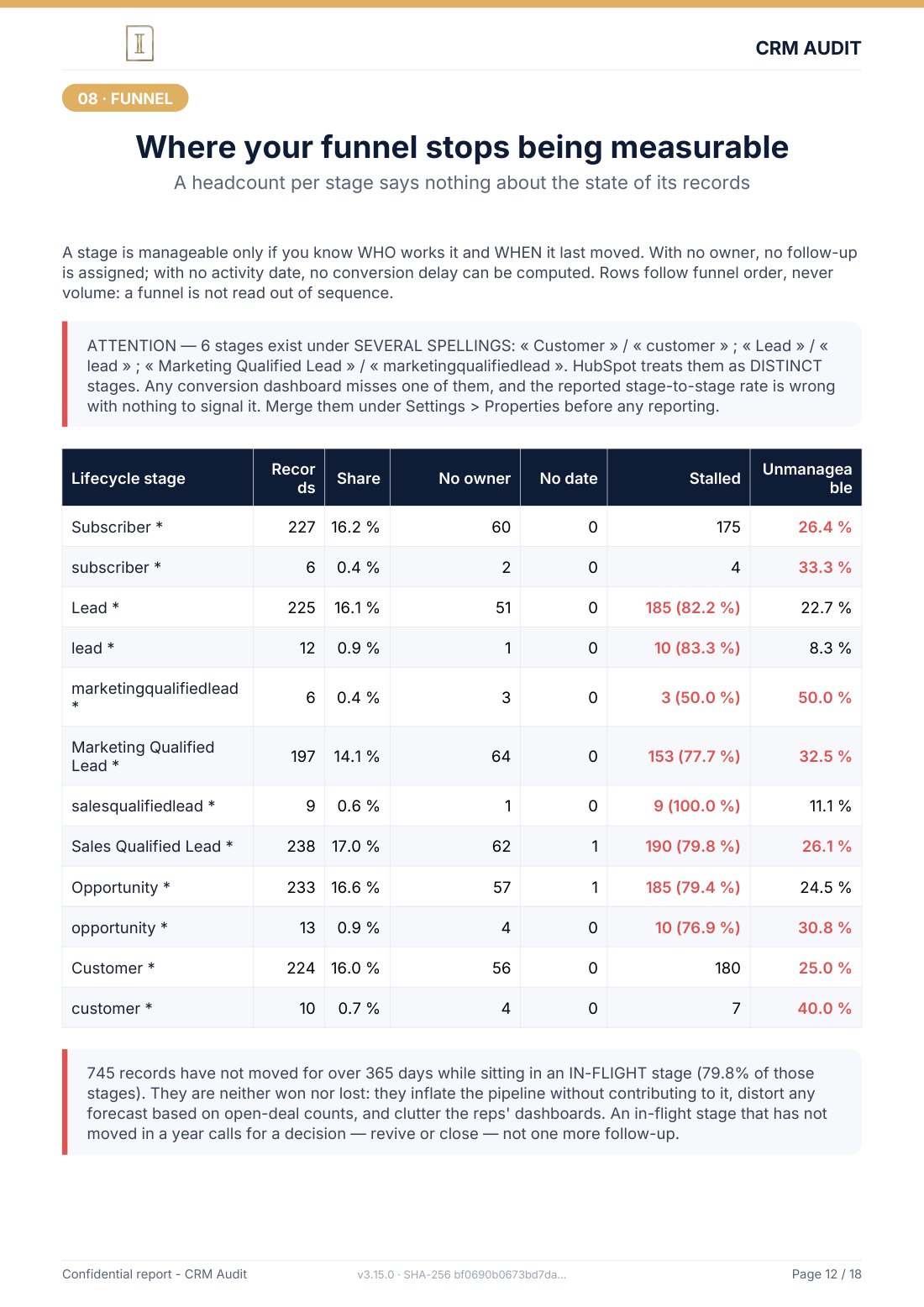
The standard stages: Subscriber, Lead, Marketing Qualified Lead (MQL), Sales Qualified Lead (SQL), Opportunity, Customer, Evangelist, Other. Two usage rules frame it:
- It moves forward, it does not go back (by default, HubSpot does not regress a lifecycle stage automatically). A customer stays a customer; a disqualified MQL does not go back to "Lead", its Lead Status will carry that information.
- It structures your core reports: Lead to MQL to SQL to Customer conversion rates, average cycle length, marketing contribution to pipeline. Skew this field and all these reports lie.
Lead Status: the state of the work in progress
While a contact is in the prospecting phase (typically between MQL and Opportunity), the Lead Status tells the daily story: New, Attempted to contact, Connected, Meeting scheduled, Unqualified, To recontact later. These values are customisable, and this is where quality is decided:
- Every value must describe an objective state, not an impression ("hot" is not a status, "meeting scheduled" is).
- Every value must have an obvious next action and, ideally, a maximum deadline before follow up.
- A lead in prospecting with no status is a lead no one can tell has been worked: it is not inspectable.
The three mistakes that break everything
- Using the Lifecycle Stage as a work status: pushing a contact back from MQL to Lead to say "not ready yet" destroys your historical conversion rates. That is the Lead Status's job ("to recontact later").
- Multiplying status values: beyond 7 or 8 statuses, reps pick at random or leave blank. Fewer values, better defined, filled in systematically.
- Importing without mapping these fields: an import that overwrites lifecycle stages or leaves statuses empty sabotages qualification in bulk, a case detailed in my import errors guide.
The duo serving management
Well combined, the two fields each answer a management question: "how many prospects at each conversion stage, and what pass through rate?" (Lifecycle Stage); "what are we doing with each lead right now, and which are stuck?" (Lead Status). With an owner on every record, you get the three columns of an inspectable CRM: who handles it, where the relationship stands, where the action stands.
Sources
Every page below has been opened and read. These are primary sources: the authority that sets the rule, or the software vendor.
- Create and edit propertiesHubSpot Knowledge Base. Both fields discussed here are properties: this is how to edit them.
- Create segmentsHubSpot Knowledge Base. To check both fields agree across a segment.
232 undefined statuses: what about you?
On the 1,400 contact demonstration base, entirely synthetic, 232 records had no Lead Status. The free mini-audit measures your base conformity within 24h: owners, statuses, lifecycle stages. A simple export is enough.
Get my free mini-audit